

I’m republishing this as a bonus, with some additional content along with a new article tomorrow because of popular demand and more questions!
There is no good or bad cholesterol, there is only ONE cholesterol molecule…FULL STOP
This got some good conversation going so I thought I would expand on my thoughts this weekend. Cholesterol is a complex and for some reason personal topic for many. I try my hardest to dispassionately debate this topic because as you know I search for truth and nothing else.
So now that we have that settled, let’s actually examine what this critical molecule does in the body instead of forsaking all else to lower it in a typically reductionist fashion oh so common to allopathic medicine. I will also present some interesting data for your consideration.
The importance of cholesterol in the nervous system was recognized as early as 1834, when JP Couerbe’s observations lead him to regard cholesterol as un element principal of the nervous system. Approximately 25% of the total amount of the cholesterol present in humans is localized to the brain, most of it in the myelin.(1)
Almost all brain cholesterol is a product of local synthesis, with the blood-brain barrier efficiently protecting it from exchange with lipoprotein cholesterol in the circulation. The brain is so smart it makes its OWN cholesterol! Spoiler alert, some statins(lipophilic in nature can cross the blood brain barrier)
In vitro studies show astrocytes synthesize at least 2- to 3-fold more cholesterol than neurons and fibroblasts. Evidence has been presented that oligodendrocytes, the cells responsible for myelination, have an even higher capacity for cholesterol synthesis than astrocytes.
Cholesterol makes up about 30% of cell membrane structure and by reducing average fluidity and protein free volume, it can influence membrane permeability to ions. So it maintains structure and function of the cell membrane.
A deficiency of cholesterol in the circulation may result in an inability to distribute vitamins K and E to vital organs with serious consequences.
From The Journal of Clinical Investigation “This structurally fascinating lipid is utterly essential to the proper functioning of cells and organisms. Cholesterol, cholesterol metabolites, and immediate biosynthetic precursors of cholesterol play essential roles in cellular membrane physiology, dietary nutrient absorption, reproductive biology, stress responses, salt and water balance, and calcium metabolism.”
What’s really fascinating is that this is just a short list of the role of cholesterol. Is it surprising to you that you almost NEVER here about these functions? Its almost as if there is a mob contract out on cholesterol. Could it be that it is exquisitely easy to manipulate through pharmaceutical means making it any drug a virtual blockbuster even if there are major side effects associated?
Now some lesser known facts surrounding cholesterol and your health…
Cholesterol participates in immune function. In animal research mice with hypercholesterolemia due to LDL-receptor deficiency, challenged with bacterial endotoxin, had a significantly lower and delayed mortality after injection with Gram-negative bacteria, compared with control mice. In humans, fewer circulating lymphocytes, total T cells, helper T-cells and CD8+ cells were found in males with hypercholesterolemia compared to men with low cholesterol levels.(2)
In 2009 the American Heart Journal published the Get With The Guidelines database which was analyzed for coronary artery disease hospitalizations from 2000 to 2006 with documented lipid levels in the first 24 hours of admission. 136,905 patients were analyzed by the end of the study.(3) The graphic below tells the tale…
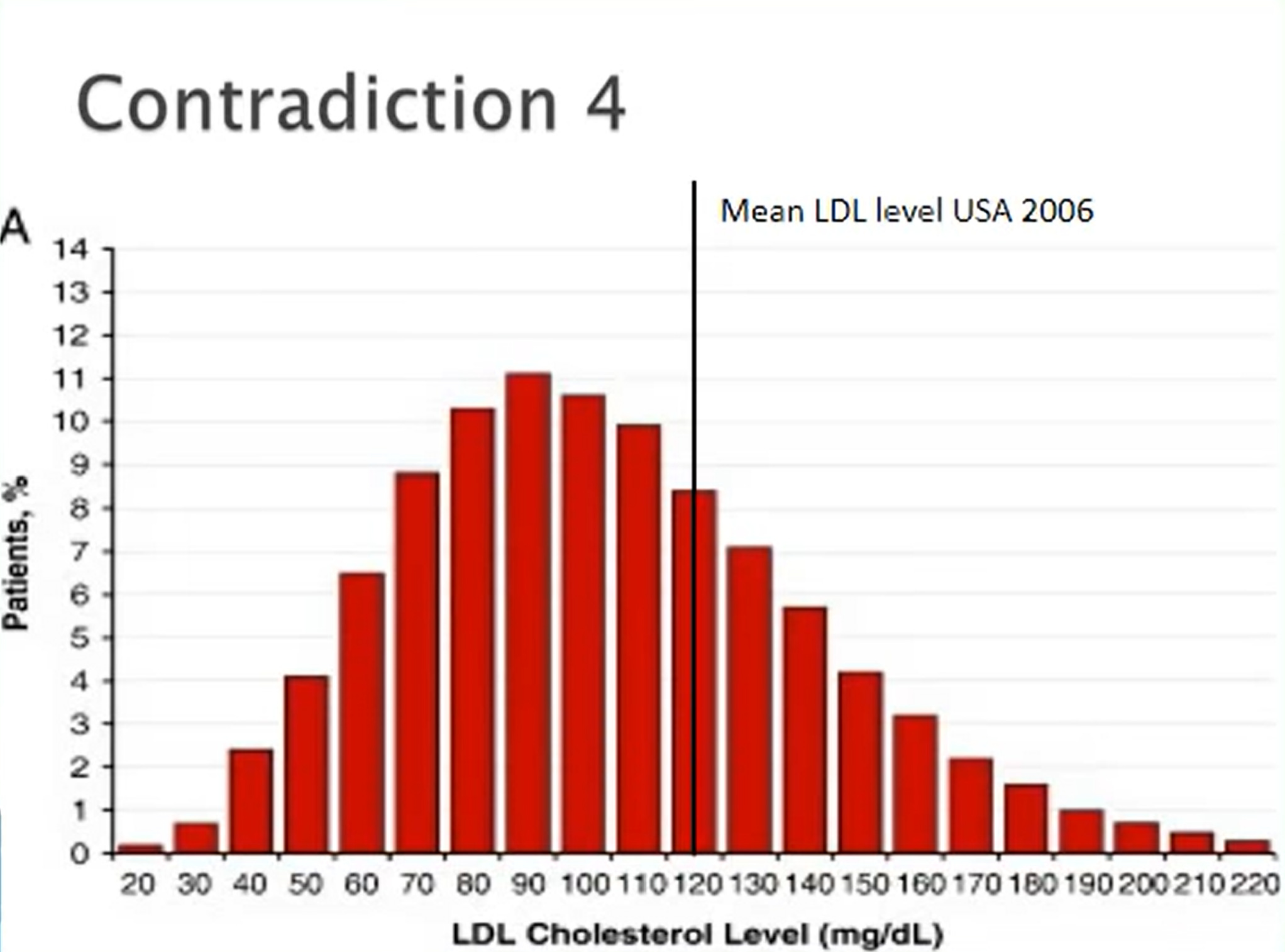
These are the LDL(C) levels on the X axis and MIs on the Y. You see heart events at the highest levels at 90mg/dL! The incidence decreases at higher concentrations and you can even see heart attacks at levels almost unheard of in human physiology…20mg/dL?! This is almost entirely incompatible with life, to quote a fantastic Scottish doctor.
Another interesting “paradox” in the Japan show that over the last 50 years fat consumption in Japan has increased by 400% and cholesterol levels have also increased in that same time period (150mg/dL to 197mg/dL)(4). But guess what decreased in that same time period? Coronary heart disease rates and stroke by 60% and 7 fold respectively. Reverse correlation tells us a lot.
How about the country of Switzerland who, after WWII, have also had an increase in dietary fat intake, concomitate with a rise in cholesterol levels and like Japan, experienced a drop in deaths from heart disease? Curious yet?
So what is a better predictor? Well one of my favorite papers is this 2008 paper in Clinics which showed that in high risk males and females not total cholesterol nor LDL were predictive of coronary disease but rather the ratio of triglycerides to HDL-cholesterol showed the strongest association with extent. (6)
Just a long fact sheet on a completely misunderstood substance that fell victim to group think, mass speculation, industry greed and moving goal posts. Facts don’t care about your career!
Please share this with anyone you think would benefit from the questions we ask and the facts we point out here. Let the quest continue!
References
1. Björkhem I, Meaney S. Brain cholesterol: long secret life behind a barrier. Arterioscler Thromb Vasc Biol. 2004;24(5):806-815. doi:10.1161/01.ATV.0000120374.59826.1b
2. Ravnskov U. High cholesterol may protect against infections and atherosclerosis. QJM. 2003;96(12):927-934. doi:10.1093/qjmed/hcg150
3. Sachdeva A, Cannon CP, Deedwania PC, et al. Lipid levels in patients hospitalized with coronary artery disease: an analysis of 136,905 hospitalizations in Get With The Guidelines. Am Heart J. 2009;157(1):111-117.e2. doi:10.1016/j.ahj.2008.08.010
4. Ueshima H. Explanation for the Japanese paradox: prevention of increase in coronary heart disease and reduction in stroke. J Atheroscler Thromb. 2007;14(6):278-286. doi:10.5551/jat.e529
5. Campbell-McBride, N. Put Your Heart In Your Mouth. Pennsylvania: Maple Press; 2017
6. da Luz PL, Favarato D, Faria-Neto JR Jr, Lemos P, Chagas AC. High ratio of triglycerides to HDL-cholesterol predicts extensive coronary disease. Clinics (Sao Paulo). 2008;63(4):427-432. doi:10.1590/s1807-59322008000400003
Hello Jay, I admire your work. You are absolutely correct. Thank you and keep it up!! God bless. Looking forward to the September retreat.
Jay, great work here and I love your appearances on Quite Frankly!
Regarding cholesterol, you I like the article that said, "that in high risk males and females not total cholesterol nor LDL were predictive of coronary disease but rather the ratio of triglycerides to HDL-cholesterol showed the strongest association with extent."
What does this mean in terms of what is a good ratio and how does one positively influence that with their diet?
Lastly, have you done any articles about statins?
Cheers!